On Wonder
And the states in which we might unlock it.

I’m sure people living within view of Mt. Rainier get used to being below a giant, looming volcano, but when I visited Washington’s Puget Sound area this week, I couldn’t get over it: It was a volcano. Right there. Covered in snow. This was normal.
My brother can see Mt. Rainier from his driveway, and I stood there with him one evening in a land thawing to cherry blossoms as the alpenglow hit the mountain. I hope you’re familiar with alpenglow; the way the sun hits and refracts in rosy sherbet tones in the high country as the land catches the last few bending rays of sun. Alpenglow slips away quick, a twin to the last bright flash in a sunset, and it is worth watching in its entirety.
We did a great many things on the west side, visiting from Spokane on my kids’ spring break, but I want to write about one of those things: an afternoon at Owen Beach. Here was saltwater far from the surf, the ocean leaking into the watery peninsula that gives Washington its top left cut. On the way to the beach, we drove past “Volcano Evacuation Route” signs. I thought about what it would be like to be a local in that town, and how used to those signs a local must get, but how surprising they seemed to an outsider. (Catastrophe waiting.) Having outsider eyes gives you a sort of superpower for noticing, which might be another way of saying that we are more primed for wonder when we travel.
If you think “beach” and picture “sand” you’ll be upended in Washington—most beaches here are made of rocky pebbles, getting gradually sandier as you travel south, like the West Coast was thrown in a rock tumbler until it came out with the smooth, gold sand of California. Just outside of Tacoma, the beach was all plum-sized rock, to the extreme delight of my nephew, who is two. His goal was to throw rocks into the water, forever. His delight in this one thing did not waver, and he tapped into a sense of wonder quickly.
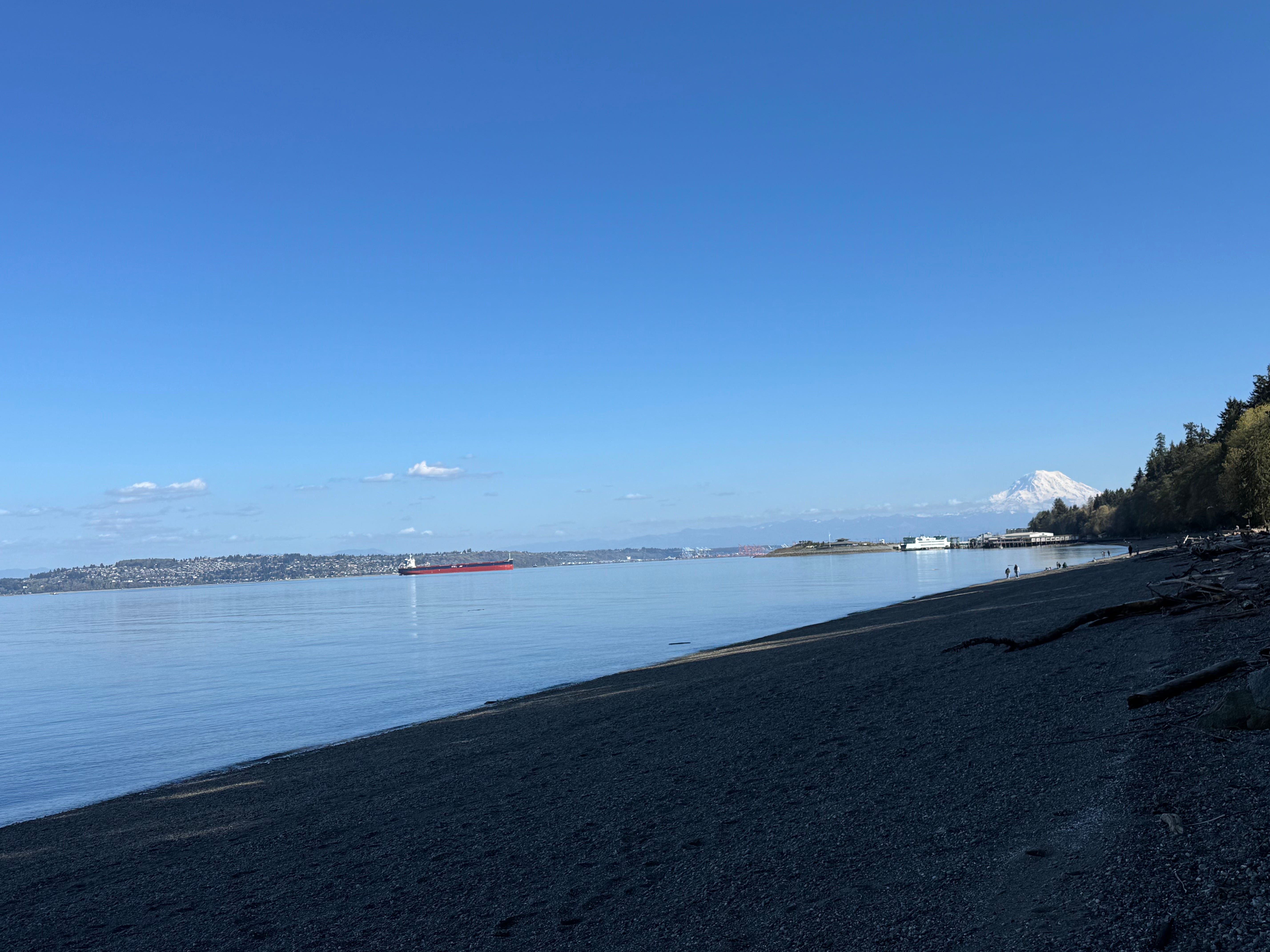
The rest of us took a bit longer to get into that mode, though it was no fault of the place. At this beach, the profile of Mt. Rainier is dramatic. Ferry boats tack from the harbor to Vashon Island, a stack of green, and the water is an unbelievable blue. Harbor seals were frequent that day; it was a delight each time they poked a dark head and whiskers above the water line, disappearing into ripples to zoom after fish soon after. The longer we stayed, the more our delight felt like it was becoming something more actionable, more conscious. We settled in. We unspooled.
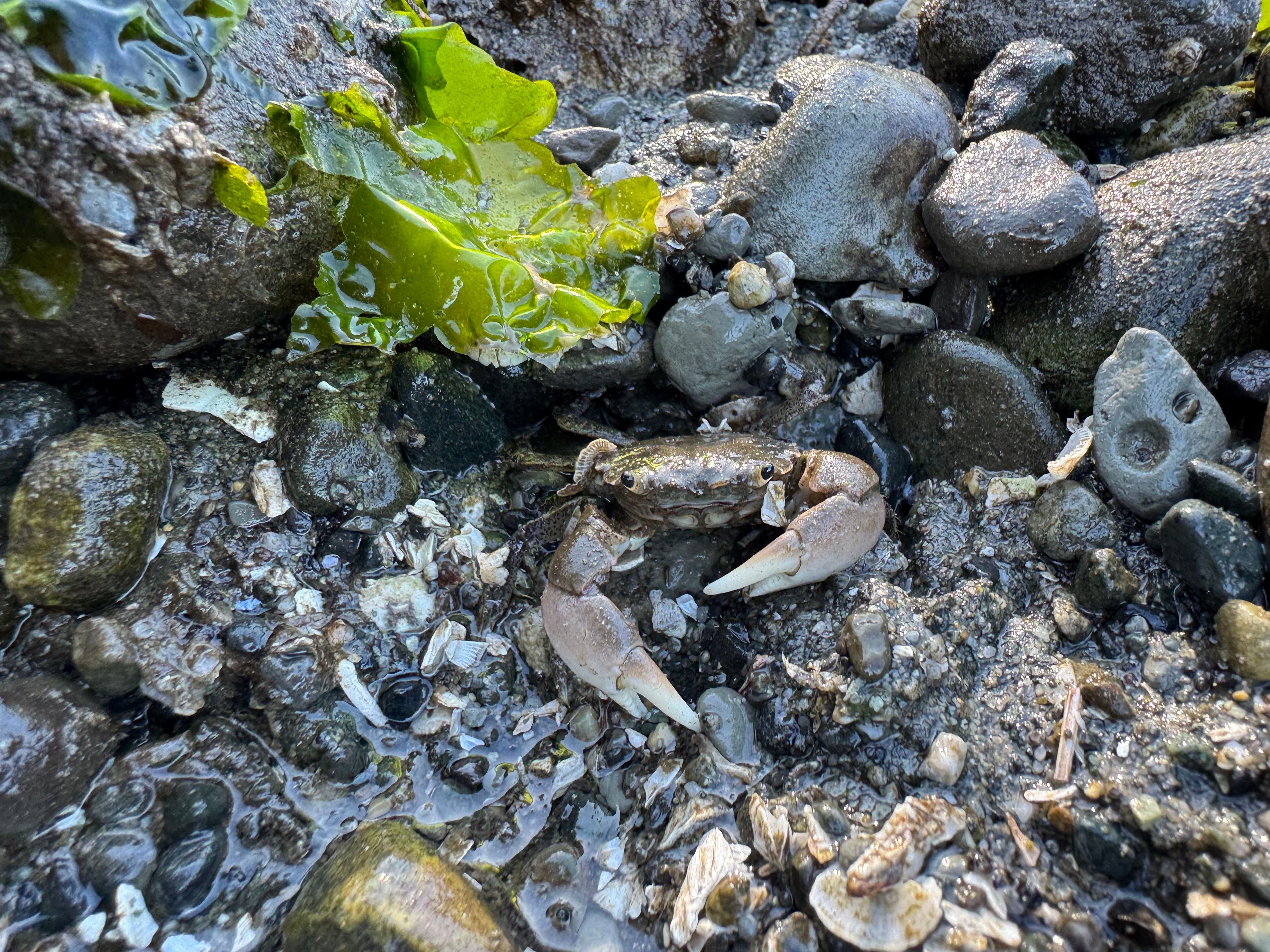
My sister-in-law knew a local’s secret: she had grown up frequenting Alki Beach, and she knew how to find small crabs. In a landscape that looked to me like barnacled rock after barnacled rock, she knew which shape and size was most promising to flip over. We followed her as she unearthed crabs the size of quarters, the size of peas, and in every rocky hue you could imagine: cream, rust, green, brown and gray. We placed them on our palms and marveled as they walked politely off to the side.
I can’t quite pin down when it happened, but it had certainly happened by then: we transformed from spectators to active wonder-seekers, full of curiosity about the micro matters of the place. We shrugged off a sense of time as we came upon a hard clay at low tide riddled with anemones, peeking into each small world. Each animal closed at our passing, like they had a secret to keep. By late afternoon, I looked back down the way we had come, looked at how the light caught on all those pockets of clay-sheen and water, and felt like I’d stumbled upon a deeper illumination. It felt good, to be that present and curious in a place. It was a mental refresh like no other. I wondered what had helped us unlock that state of mind.
Inevitably, the whole beach gave up to shade, the top of Mt. Rainier holding the light, and we started back for the parking lot. My four-year-old had been on my back for a while by then, refusing to walk any longer, and my ankles were tired of slipping over the rocks with the extra weight. I was all “wondered out,” thinking ahead to dinner. But just before the beach restrooms, a man with a long-lens camera went eagerly jogging in the opposite direction. We looked behind us and laughed with some people nearby that he must know something we didn’t. Shortly, another person with a camera the size of a cat strode past. Orcas, they told us. They’d just been spotted under the Tacoma Narrows bridge.
My sister-in-law’s eyes lit up, and she gave us that look: She’d been waiting her whole life to see orcas in the wild. Though we were laden with tired kids, spring day settling to a chill, we told her she had to go. She took off on the heels of the photographers, and I settled onto a large piece of driftwood with my young daughter and nephew. They tapped right back into it again: my nephew used a stick to dig up rocks, pointing out each discovery to me, and my daughter asked for my smoothie order as she gathered up ingredients from the beach.
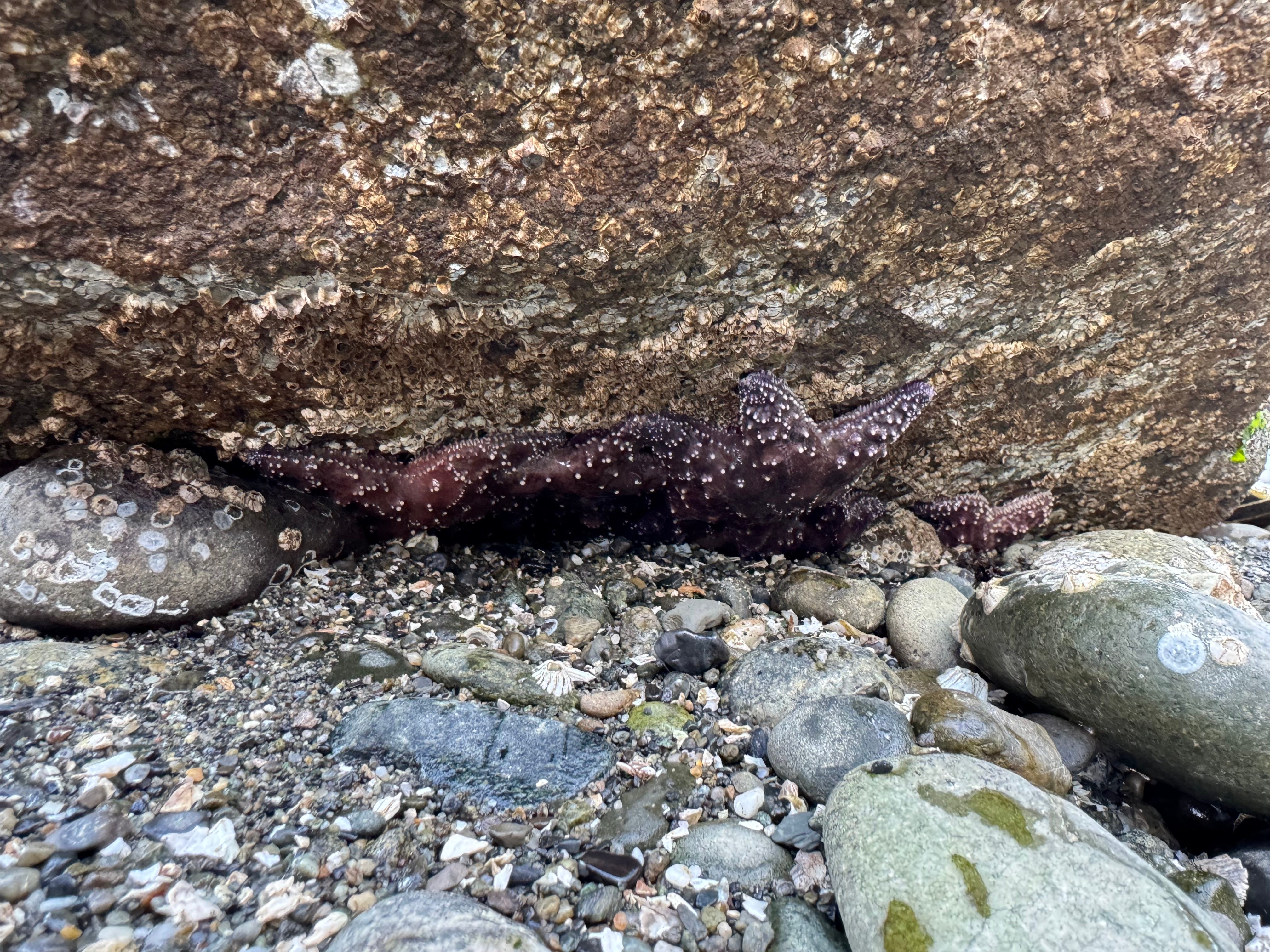
I knew it would be a while until my sister-in-law returned. I ordered an imaginary pineapple smoothie and stared at the water as the light continued to wane, its refraction hiding the spotted seal bodies and orange sea stars we’d spotted earlier in the day. I considered what the magic ingredient was: if wonder came more readily when we were somewhere new, or next to wildlife; if it aligned with capacity, arising only when other needs were met (certainly); if it just required spending time in a place, or if it could be triggered by movement. At my peak of wonder that day, I had been overcome with a desire to smell the eroding cliff edge, taking a few deep whiffs of soil, salt, and fern and feeling new. Shortly after, I climbed and stood on a large rock, just because, inhibitions doused by how good it felt to be lost in exploration.
Even if we couldn’t see the orcas in the water that day — and we wouldn’t — the prospect of orcas was a joy we shared with those photographers jogging down the beach. The moments of eyes-to-lens, searching, seemed just as rich.
I love this meditation on wonder, Lisa. It has me thinking about presence: when I’m in a state of nature-induced wonder, selfhood falls away. It’s easier to drop inhibitions and be in the moment. At the same time, the physical world feels more immediate, and I have a keener sense for my body in space. Is this a paradox? A clue to the nature of wonder, or perhaps a deepening of its mystery?