On The Things We Pass Down

My grandmother told me to grab a notepad. She was going to tell a few stories, and said I’d need to take some notes. It being a digital age, I tipped my head at my phone and told her I could take notes there. She wasn’t a woman I’d disobey, but she was already looking to direct me toward a pen and pad I could borrow, and I wanted to save her the trouble. She was sitting with an oxygen tank in her living room. She had some items she wanted to pass down to my kids and me.
My grandma has done this for a lot of years. When I was in college, she gave me vegetables and newspaper clippings. She would text me to swing by whenever I visited home, saying she and my grandfather had a burden of ripe zucchini, some tomatoes, an article they thought I’d want to read — they’d saved the whole magazine for me. Each time, I would stop by. Even then I realized the things were just a means for a bigger exchange: time together. Time to look one another in the eyes again, and smile.
The objects my grandparents gave me varied over the years, most of them mundane. One time it was an extra pair of kitchen tongs they’d decided they didn’t need but maybe I did. Another time, it was a notepad they’d received in the mail, courtesy of their donations to St. Jude’s. Often, the items were things I did not need. Sometimes, the items were things I did not want. But I took them every time. Taking the objects was obligatory. An acknowledgment of love. For each item said, I’ve been thinking of you while we were apart.
My grandmother is becoming more purposeful in what she gives me. This time, there was an old vase meant for my daughter. The story tumbled out, and I took notes as she told it: When my grandmother was five, she became sick at school and was sent to walk herself home. On the way, she collapsed on the sidewalk in front of a family friends’ house. Her appendix had burst. She could have died then, in 1945, but they got her to the hospital. There she received flowers in a vase in the shape of a little girl in a bonnet. She kept the vase, and the story, for another 81 years. Keeps the story still. Has passed down both, now, to my daughter, who is four, who hugs my grandmother generously despite the strange cord snaking from her nose, who is a fierce little thing herself made of stories.
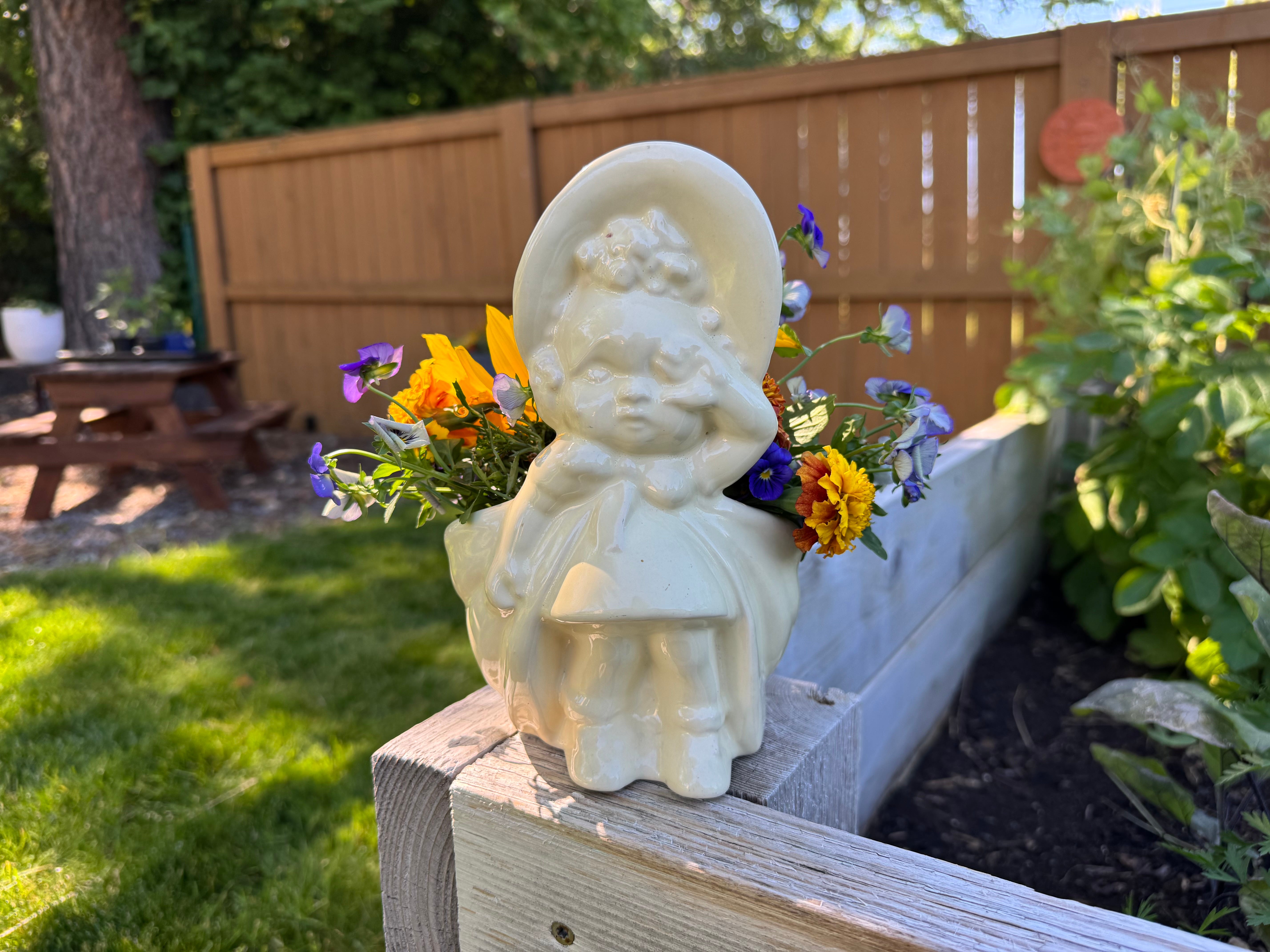
I get suspicious when grandmothers start giving me precious items, but I’d do the same thing in their shoes: pass it on while I could still pass the story with it. The storytelling must have made my grandmother feel good, for she got up and walked to the kitchen and began instructing me to take down the old dishware from her top shelves, pointing out glass pitchers and china plates, things she had kept from her mother, from their wedding, from their travels to other countries.
I can only take so much of a thing like that at a time, sifting through 80 years of life in a matter of minutes. I told her I needed to go check on my son, who was helping my grandfather find the pieces of an old sailboat he planned to donate to a sailing club. The guy he’d called up would be by within the hour.
They couldn’t find the keel. They had located the rudder in my grandfather’s shed (another time capsule of stories and things), but they needed each part for the boat to be of any use. They’d looked through everything twice. Had even texted my uncle, the last person to sail it a half-decade ago. I didn’t know what a keel looked like, but my grandpa said it would be the same wood tone as the rudder, light and smooth, about four feet in length. There were snow shovels and old hand saws and yard toys that us grandkids had used, the curve of a wooden headboard, a stack of oars for the canoe. Nothing looked like what my grandfather described. He gave up and left to locate the sail in the garage. I took up a flashlight.
I was hoping hard to find the keel. Something was knotting my stomach, something about all the things my grandmother was giving me, out of breath from the effort of it. How could I receive that much hope and heaviness and love with grace? Later, I’d look up the parts of a sailboat and learn that the keel was the stabilizing weight, a fin that kept the boat from capsizing. I’d always associated the word keel with the long, high-pitched note made by a killdeer, the master of redirection, its cry a mix of urgency and fear. I couldn’t help that my grandmother’s health was deteriorating, but maybe I could help my grandfather find the last piece to a sailboat.
My fourth time through the shed, by some stroke of luck, I found the keel nestled with the lean of a stack of lawn chairs. We celebrated when we found it, each of us cheering in a cheesy way that felt good. My daughter even ran inside to share the good news with her great-grandmother. It was just an item, a random one at that, but it brought us together in a moment of celebration. A small joy we got to share.
It was time for us to go, then. My kids and I had stayed for an hour, and the guy would be coming by for the sailboat any minute. I packed the new items from my grandma gently in my car—mixing bowl and pitcher and vase and vintage ring—but they stayed pitched in my heart on the drive home, and the heaviness felt like one word. Keel. A grounding, and a longing, both.
This is just brilliant Lisa, just brilliant.