
This week is the end of dryland wheat harvest season, and I’ve missed it.
The reasons for this are multifaceted. For one, I was gallivanting around the Washington coast with my family, brother’s family and parents, something we’ve reveled in doing ever since my dad retired from farming. Each July and August for the last 30+ years we have been tied heavily to the farm, and traveling anywhere during harvest season feels like a guilty pleasure.
Another reason is that I live 190 miles from the farm. But we have excellent family friends who have taken over farming my father’s ground, and I’ve been known to drive that mileage just to catch a combine ride.
The real reason I might have missed it this year is that I finally began to wonder what it was I hoped to gain. I wanted my kids to see how wheat was cut, sure. I wanted to re-immerse in the hot, dry sensory world of harvest, for nostalgia’s sake. But what would a combine ride do to make me feel more connected to that place and way of life? How connected could I still hope to be?
There are some threads that run deep in us that start to wane. Maybe they get dim from time or maybe they begin to dim when we don’t need them as much anymore. For the first summer, I felt okay that my family’s agriculture history was that: history. I was relieved my dad, in his late 60s, could finally catch the physical break from field work he deserved. We would still carry farming with us in a thousand ways. And I felt that: that it would stay. I felt I could hold it without needing an annual renewal to prove it was still a part of me. I had one chance to snag a combine ride this summer and took my kids swimming in a neighbor’s pool instead. (Guilty pleasure #2.)
Nevertheless, I am working on a literary memoir about growing up in conventional agriculture. It is about my summers working wheat harvest as the only woman in the field, about changing and leaving that world and still honoring it for all of its beauty and complexity. To that tune, and for all the dryland crews who are at the tail-end of weeks of heat, sweat and exhaustion on this red-flag extreme-fire-risk first of August day, I’m sharing a little scene from my forthcoming book (forthcoming when, I’m uncertain, but hell-bent that forth-come it will). It speaks to how bone-deep it is for us all, even if we leave it. I hope you enjoy —
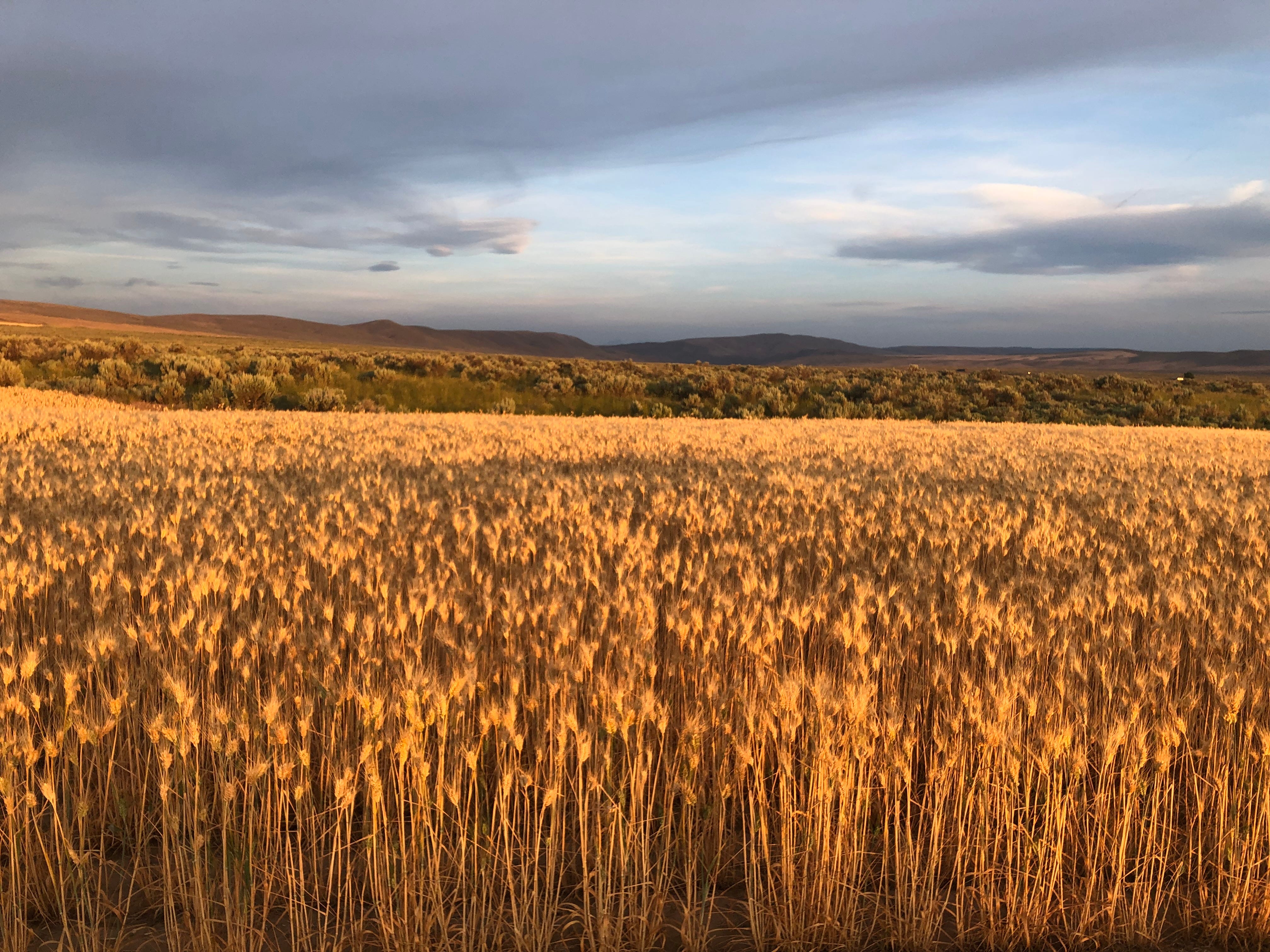
Let me explain how a combine works in the same way my father did. Picture a farmer and his young sun-soaked daughter sitting on the front steps of the farmhouse. It’s twilight, his boots still on from the field, and he has picked a head of wheat on his way in to show his daughter. He smells like dried sweat, machine grease and Corona with a twist of lime. It’s the magic hour in the desert when the temperature starts to dip, a relief made palatable with the breeze that kicks up every evening, the click-click-whiiiiir of grasshoppers at a pause.
“There’s a part in the combine’s belly that grinds the wheat out, like this,” the farmer says, holding a single head of wheat in one thick palm and closing the other over like he’s cradling a moth. He moves his hands together as he presses. A few slow, compressed circles. He opens his top hand then, and, like a magic trick, wheat berries have appeared. They sit in his palm with a mix of chaff and wheat beard and stem.
“Then, a big fan in the combine blows off all the stuff we don’t want,” the farmer says. He leans toward his cupped palms and blows a strong flow of breath. The chaff, light as an eyelash, tumbles up and out of his hands-world. He rubs his palms in circles again. Sorts wheat from chaff with a strong breath once more. Then he holds out twenty or so golden wheat berries to his daughter, who delights in taking them from his palm.
“You try,” he says.
So the daughter takes up a second head of wheat, and puts it between her palms, just like her father has. Only, starting in on one circle is enough to make her jump and open her hands. Her skin is too soft. The serrated beard of the wheat pulls like barbed sandpaper. Her palms are torn with micro-scratches too small to see.
Her father takes the wheat from her, crushes and sorts it with his own great callouses, then hands her back the wheat berries. It will be years before the girl can do this without cutting her hands, but she will remember it, always: the way her father’s hands and breath moved, the way he made the combine seem alive to her, in the same way he made everything seem alive to her. How he displayed the wheat berries in his palm like a treasure.